
At The Myers Law Group, we understand the challenges California workers face when employers require off-the-clock work. California labor law is clear: employees must be compensated for all hours worked, and any expectation to perform work without pay is illegal. Many employees are unaware of these rights, especially when off-the-clock tasks are subtle or framed as “voluntary.” However, the law treats any implicitly required work performed outside recorded hours as compensable time, and failure to pay for this time can constitute a wage violation. Recognizing and addressing these violations is critical to ensuring you receive proper compensation and that your employer adheres to California labor standards.
Managing Partner Attorney Attorney Attorney Attorney Attorney Attorney Attorney Attorney
David P. Myers

Adam N. Stern

Ann Hendrix

Robert Kitson

Justin Crane

Doug Smith

Jason Hatcher

Morgan J. Good

Alvin Ferrara
What Constitutes Off-the-Clock Work 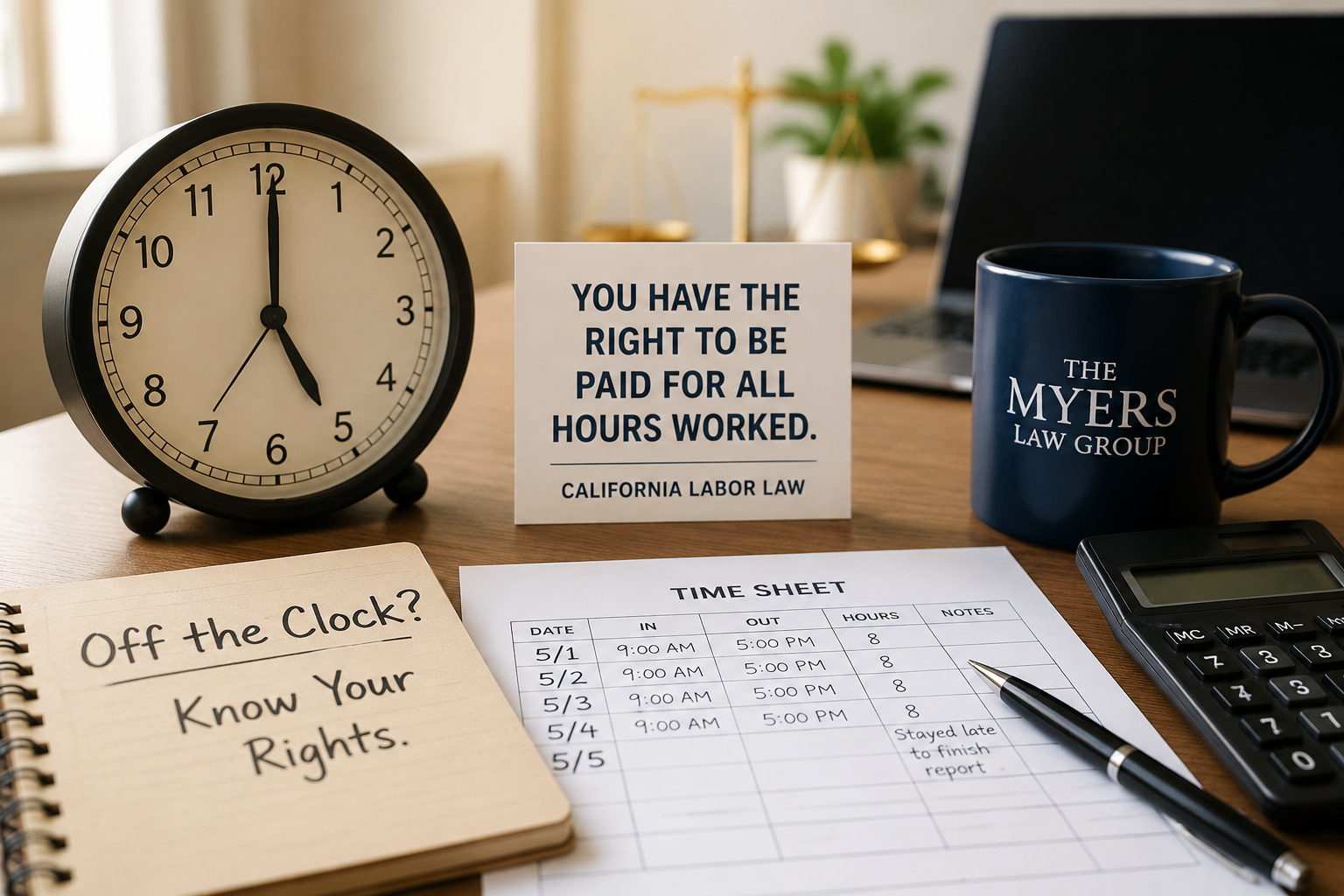
Off-the-clock work encompasses any duties performed outside of recorded hours that are required, permitted, or expected by the employer. Typical examples include:
- Checking and responding to emails before clocking in.
- Attending mandatory meetings that occur outside scheduled hours.
- Completing reports, restocking, or other tasks after clocking out.
- Performing preparatory or closing tasks that contribute to the core business operations.
Even when employers suggest that this work is voluntary, California law often interprets pressure, either direct or indirect, to perform these tasks as a requirement. Employees who comply are still entitled to compensation for all time spent performing these duties, including applicable overtime.
California Wage Protections for Employees
The California Labor Code provides robust protections for employees against off-the-clock work and other wage violations. Under sections 204 and 510 of the Labor Code, employers are required to compensate employees for every hour worked, including overtime for non-exempt employees. Section 1197 mandates payment of at least the state minimum wage for all hours worked. Violations may result in back pay, civil penalties, and administrative enforcement actions by the California Division of Labor Standards Enforcement (DLSE). In addition, employees may recover waiting time penalties under Labor Code §203 if wages remain unpaid after separation from employment. These protections underscore the state’s commitment to fair and lawful compensation practices, making off-the-clock work not only a civil violation but potentially subject to significant financial consequences for employers.
Choosing an Employment Law Attorney Recovering Damages in an Employment Law ClaimRelated Videos
Common Situations Leading to Wage Violations
Off-the-clock work often arises in industries and roles where employees have high interaction with customers, strict operational timelines, or flexible work expectations. Examples include:
- Retail workers who perform closing duties after their shifts end, including restocking or cleaning.
- Hospitality staff, including servers or bartenders, completing prep work before clocking in or closing responsibilities afterward.
- Office employees answering emails or phone calls outside scheduled hours, particularly if managers monitor or expect this communication.
- Delivery drivers performing pre-trip vehicle checks or documentation before official work hours.
Even employees in salaried positions may be affected if non-exempt tasks are performed without recording hours. California’s wage laws are designed to ensure that the employer cannot bypass compensation obligations by misclassifying duties or exempt status.
Overtime and Missed Break Violations
Off-the-clock work frequently intersects with overtime violations. Non-exempt employees are entitled to overtime pay for hours exceeding eight in a day or forty in a week. When work goes unrecorded, employees may miss the opportunity to receive overtime pay. Similarly, California labor law mandates meal and rest breaks for employees working certain durations (Cal. Lab. Code §§ 226.7, 512). Off-the-clock work can result in missed breaks, further compounding wage violations. Employers must compensate employees for missed breaks with premium pay, in addition to regular and overtime wages. Understanding these overlapping protections is essential to asserting full compensation and ensuring labor law compliance.
Results
Documentation and Reporting of Off-the-Clock Work
Employees should maintain detailed records to protect their rights. This documentation may include:
- Daily logs of hours worked, including off-the-clock tasks.
- Emails, text messages, or memos from supervisors indicating expected work outside regular hours.
- Notes detailing tasks performed outside recorded time and any directives from management.
Maintaining accurate records is critical when filing a wage claim with the DLSE or consulting a California employment law attorney. Statutes of limitations typically allow claims for unpaid wages up to three years from the date the wages were due. Prompt action ensures that claims remain valid and enforceable.
Legal Assistance and Recovery of Unpaid Wages
The Myers Law Group can assist employees in understanding their rights, evaluating wage claims, and pursuing compensation for off-the-clock work. Legal representation can include:
- Reviewing employment records and communications to determine the scope of violations.
- Calculating unpaid wages, overtime, and penalties.
- Filing claims with the DLSE or pursuing litigation against noncompliant employers.
- Negotiating settlements or representing employees in hearings to secure fair compensation.
With professional guidance, employees are better positioned to recover unpaid wages and hold employers accountable for wage law violations.
Case Illustration
A retail worker in Santa Barbara regularly stayed after shift hours to restock shelves and perform inventory checks, believing it was a voluntary expectation. After documenting these hours, the employee contacted The Myers Law Group. Legal counsel filed a claim with the DLSE, resulting in compensation for all unrecorded hours plus applicable penalties. This example demonstrates the importance of record-keeping and timely consultation with employment law experts to enforce employee rights.
Preventing Wage Violations and Protecting Employees
Employees can take proactive steps to protect themselves from off-the-clock work and related wage violations:
- Familiarize themselves with California labor laws regarding hours worked, overtime, and breaks.
- Record hours worked accurately and consistently.
- Avoid performing tasks without pay unless clearly voluntary and documented.
- Seek legal advice if there is uncertainty about the legality of employer directives.
Employers must adhere to labor laws, but employee awareness and proactive measures are vital to safeguarding compensation rights.
Working off the clock is a violation of California law, and employees are entitled to recover wages for all hours worked. The Myers Law Group provides expert guidance to ensure that workers understand their rights and obtain compensation for unpaid labor. Employees should maintain detailed records and seek legal counsel to enforce their rights effectively. By addressing off-the-clock work promptly, employees can secure the wages they have earned and ensure compliance with California labor laws.
Disclaimer
This information is for general understanding and is not legal advice. Consult an attorney for guidance tailored to your specific situation.
To learn more about this subject click here: The Role of Class Actions in Wage and Hour Claims